Publication 19 Dec, 2024 / Sunglasses.bg / 20
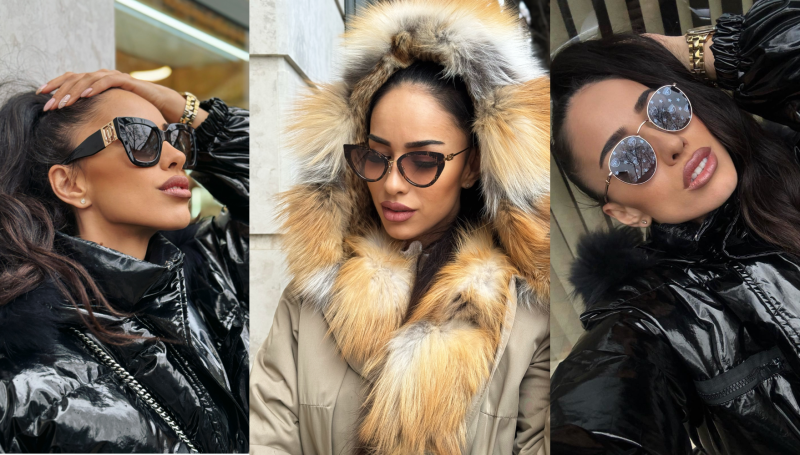
If you think sunglasses season ends with the last warm days of autumn, we have to disagree – there is no such thing as a sunglasses season. In winter, it is just as important to give your eyes full protection from ultraviolet radiation.
Should I wear sunglasses in winter?
The main purpose of sunglasses is to block harmful UVA and UVB rays, which can damage the retina and seriously harm your eyesight.
The consequences of harmful UV exposure include macular degeneration of the retina and clouding of the lens, which may later lead to cataracts. UV rays reach the ground freely at any time of year – even on cloudy days your eyes are exposed to ultraviolet radiation.
On a sunny winter day, the rays reflect off the snow and can cause double damage to the eyes, leading to photokeratitis, or snow blindness – a burn of the eye surface. In the city this is almost impossible, but in the mountains it happens easily. That is why it is so important to have quality sunglasses with you when you travel to ski resorts.
Even in the city, you should still wear sun-protective eyewear. Cloudy weather is no reason to give up your glasses either – in that case choose a model with light (category 1–2) lenses. Glasses also protect your eyes from the wind, which matters at any time of year: wind not only makes your eyes water, it can also blow dust into them and cause irritation.
How to choose winter sunglasses
1. Check for UV protection. The UV markings on the glasses will tell you – manufacturers use different wording, such as UV plus a number showing the wavelength of blocked rays, or 100% UV protection. Protection is essential, otherwise there is no point wearing sunglasses. Worse still, dark lenses without UV filters cause double harm: behind dark lenses the pupils dilate and the eye absorbs even more UV radiation.
2. It is best to have two pairs: dark ones for sunny days and light ones with almost clear lenses for cloudy days. Before buying, make sure both have UV filters.
3. Choose plastic frames. Metal frames can be uncomfortable in the cold – cold metal feels unpleasant on the skin. But choose your plastic model carefully, too: do not save on quality, because low-grade plastic can crack in severe frost.
4. Buy glasses only from specialised opticians and websites. This increases the chance that your sunglasses really have UV filters – anything can be printed on a frame, but retailers who value their reputation work only with trusted suppliers. You can always ask for a certificate of conformity to make sure the product is authentic.
5. Choose glasses with polymer (plastic) lenses. Glass lenses can be dangerous: on impact they may shatter into small pieces that could get into your eyes. If you slip and fall, plastic lenses will at most crack.
6. Consider polarised sunglasses. If your winters are snowy and sunny, polarised lenses will protect you from glare and help you see clearly even in dazzling conditions.
7. Think about the purpose of the glasses. Special glasses for the mountains or the open sea, which let through only about 5% of light (marked category 4 on the temple), are better not worn in the city. At high altitude or with bright sunlight reflected off water, such dark tint is justified, but not in everyday conditions. For daily wear choose category 1 or 2 lenses, otherwise you will hardly see anything. Do not use ski goggles for everyday wear – and, conversely, use special eyewear for skiing or a sea cruise.
8. Pay attention to fit: the glasses should sit snugly on your face and stay in place when you lean forward or turn your head quickly. If they are too loose, they may slide down under the weight of your hat. At the same time, they should not be too tight, or they will cause headaches and you simply will not want to wear them.
What to wear with sunglasses in winter: tips from stylists
Glasses can be either a complementary or a leading accessory. In the first case they follow the overall mood of your outfit; in the second they create a bold accent. It all depends on the effect you want.
For a business look, for example, choose discreet glasses, since that style has fairly strict rules. With coats and classic suits, wear traditional, understated models with brown or grey lenses.
For a romantic look, go for feminine shapes such as a sexy cat-eye or more delicate butterfly glasses. Unisex glasses of any shape suit a sporty style.
If your outfit is built on bold trends, complete it with fashion-forward models – glasses with bright frames, oversized designs and futuristic shield sunglasses work best.
By the way, shield sunglasses are an excellent tool for a wow look. Add them to a simple outfit of a T-shirt, jeans, a shearling coat and a beanie, and your look instantly becomes current and stylish.
Shield and oversized glasses fit into almost any sporty-chic, romantic or casual look. If you easily combine the seemingly incompatible and love to experiment, statement glasses are definitely for you.
Hats and glasses
If you wear a hat, a scarf or a classic beret, it is best to match your glasses to the overall femininity of the look. We suggest going retro: rounded-square oversized glasses made fashionable by Jacqueline Kennedy, or large oval models with thick plastic frames. Cat-eye or butterfly glasses are another option.
Any frames suit casual headwear – a beanie, a baseball cap or a snood. Focus not on the style, but on what suits the shape of your face.

 EU – incl. local VAT
 България – вкл. 20% ДДС
 România – TVA 21% inclus
 С. Македонија – без ДДВ
 Polska – z VAT 23%
 Österreich – inkl. 20% USt.
 Česko – vč. 21% DPH
 Deutschland – inkl. 19% MwSt.
 España – IVA 21% incluido
 France – TVA 20 % incluse
 Ελλάδα – με ΦΠΑ 24%
 Hrvatska – uklj. 25% PDV
 Magyarország – 27% ÁFA-val
 Italia – IVA 22% inclusa
 Slovenija – z 22% DDV
 Slovensko – vrátane 23% DPH